About Me
WHERE I CAME FROM
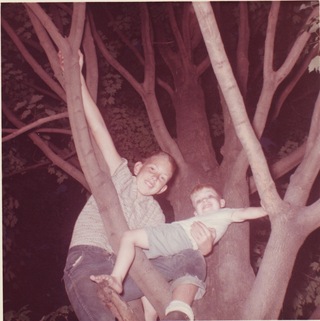
I grew up in the small town of Williamsburg on the banks of the Cumberland River in southeast Kentucky. Everything about Williamsburg was small. We had three stop lights (In the 40 years I've been gone the town has added three more.).
The town's school was a single brick building for all 12 grades. The school had a front lawn shaded by tall oaks and enclosed by a hedge. We weren't allowed to play on the lawn. A few kids rode the school bus, but most of us walked to and from school. Unless we stopped to shoot some hoops or watch a freight train loaded with coal rumble across Main Street, we could walk anywhere in town in less than 30 minutes. As I said, it was small.
The weary-looking house where I grew up sat on the edge of a field about 100 yards from the Cumberland River. Across the water a tree-covered mountain filled the sky. Some of my earliest memories are of summers fishing and swimming and playing down at the river.
I often played by myself and the books I was reading--Light in the Forest, The Adventures of Daniel Boone, The Last of the Mohicans--informed my imaginary world. This was, after all, Daniel Boone country. Boone and many other settlers passed through the Cumberland Gap, which was just a few miles to the east.
When I read Tom Sawyer and Huck Finn, my imaginary play moved to one of the river's small islands where I built a lean-to beneath sugar maples. And I found several logs that had washed ashore during the spring floods and nailed boards across them to make a raft. Using a pole, I pushed my raft a half mile or so up river and then drifted back down while, stretched out on my back, I gazed at the clouds and dreamed of a future.
I had turned 11 that summer of the raft. The following summer I walked down to the river and looked across the narrow inlet at the island, The spring floods had taken my lean-to away, but they had washed my raft up on the river bank. I stared at it for a long moment. Then I turned and walked away.
WHERE I WENT
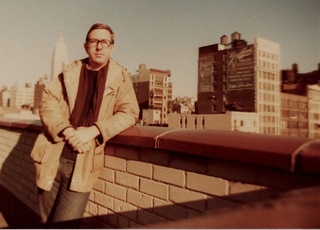
I had never considered myself lucky until I moved to Manhattan.
With a few dollars in my pocket and even fewer job skills I moved north in the summer of 1977. It was a dumb thing to do, but I wanted to be a writer and New York was where real writers should be, or so I thought at the time. But that sounds more thoughtful than what actually happened.
I was a graduate student at Emory University in Atlanta. I had been excited about going to Emory and studying history. But then in the winter of 1976 I went with one of my new school friends to New York City. I remember walking along Central Park South at dusk seeing my breath in the cold air and the steam pouring out of manhole covers and the sidewalk crowded with well-dressed people in a hurry to get somewhere while the streets were full of cars, mostly yellow cabs, frozen it seemed except for the endlessly honking horns. I remember the smell of roasted chestnuts and hot, slightly burned pretzels on the push carts. I was in love. For the first time I was completely swept off my feet. At the end of the school year I loaded my few books and clothing into my 1967 Volvo and drove toward New York City.
Attempting to be practical, I moved to Monmouth County, New Jersey about a 45-minute drive along the Garden State Parkway south of Manhattan. My idea was to get a job as a reporter with one of the state's best newspapers, The Asbury Park Press. Never mind that my only newspaper experience had been a few months of sweeping floors and writing wedding announcements for my hometown weekly. I had never worked on a school newspaper. I had never even taken a journalism class in college, although I had always intended to. Fortunately the good men and women who gathered and wrote the news for the Asbury Park Press weren't given to open ridicule.
I became a stringer, covering one or two municipal meetings a day in Monmouth County's 54 municipalities. Each night I sat through school board meetings, planning board meetings, city council meetings, zoning board meetings. After spending three or four hours at a meeting, I went to the newsroom to write a two or three paragraph summary, finishing up at 11 or 12 in the evening. For each meeting I attended I was paid $10. We all can't start at the top.
I rented a room in a two-story frame summer house by the beach. The rent in the off season was really cheap. Never mind that the old house wasn't well heated or insulated. I liked it best in the winter when few people were about. I didn't own a television. The nights I didn't cover a meeting I walked the boardwalk gazing at the stars and listening to waves slapping the sand. I had just seen the Atlantic Ocean for the first time a few years earlier and its moods fascinated me.
When a north-easterner blew up the coast bringing snow, rain, and winds up to 70 mph, I would sit in my drafty room listening to the house creak and shake. If the winds weren't too strong I walked the boardwalk dodging sprays of foamy saltwater leaping over the sea wall or staring at the seething ocean. It gave me the same gut feeling I felt standing on the edge of a tall cliff.
After learning that one of my childhood friends was doing his medical residency in Manhattan I started going into the city on weekends. (More later. M. L. Cooper)
RECENT BOOKS
Up Close: Theodore Roosevelt (Viking, 2009).
Jamestown, 1607 ( Holiday House, 2007).
John Paul Jones: Hero of the High Seas (National Geographic, 2007).
BOOKS PUBLISHED BY HOUGHTON MIFFLIN HARCOURT:
Dust To Eat: Drought and Depression in the 1930s (2004).
Remembering Manzanar: Life In A Japanese American Relocation Camp (2002).
Slave Spirituals and the Jubilee Singers (2001).
Fighting For Honor: Japanese Americans and World War II (2000).
Indian School: Learning the White Man's Way ( 1999).
Klondike Fever: The Famous Goldrush of 1898 ( 1989).
Racing Sled Dogs: An Original North American Sport (1988).
BOOKS PUBLISHED BY LODESTAR / E .P. DUTTON
Double V Campaign: African Americans and World War II
Hell Fighters: African Americans in World War I
Bound for the Promised Land: The Great Black Migration
From Slave to Civil War Hero: The Life and Times
of Robert Smalls
Playing America's Game: The Story of Negro League
Baseball
(The publisher closed the Lodestar imprint and these books are out of print, but used copies are available on the Web.)
AWARDS & SUCH
Golden Kite Award for Best Nonfiction Children's Book of 2004 from the Society of Children's Book Writers and Illustrators (SCBWI) for Dust to Eat: Drought and Depression in the 1930s (Clarion/Houghton Mifflin, 2004).
Special Award for Young Readers from the Colonial Dames of America for Dust to Eat: Drought and Depression in the 1930s (Clarion/Houghton Mifflin, 2004).
Capital Choices 2005, Dust to Eat:Drought and Depression in the 1930s (Clarion/Houghton Mifflin, 2004).
Carter Woodson Award for the Best Children's Book of 2003 on ethnicity; the National Council for the Social Studies for Remembering Manzanar: Life in a Japanese American Relocation Camp (Clarion/Houghton Mifflin, 2002).
PAST SPEAKING ENGAGEMENTS
Newman University, Wichita, Kansas
Society for Children's Book Writers and Illustrators annual conference.
National Council for the Social Studies annual conference.
Baltimore Children's Literacy Jamboree.
Children's Book and Author Showcase, Frostburg, MD.
Saint Patrick's Episcopal Day School, Washington, DC.
Abington Friends School, Philadelphia, PA.
St. Albans School, Washington, DC.
Union College, Silver Spring, MD.
Queens College, New York, NY.
Timber Lane Elementary School, Falls Church, VA.
Walden School, Louisville, KY.
Washington (DC) Independent Writers annual conference.